

One of the most important forms of chromatography is High Performance Liquid Chromatography (HPLC). This liquid chromatography technique is used to separate mixtures of substances in order to identify their individual components and determine their concentrations. In addition to analytical applications, it is widely used in the chemical industry to isolate specific substances from a product, such as during insulin production.
Process and Challenge
In simple terms, chromatography involves a mobile phase and a stationary phase, both located within a chromatography column.
In HPLC, the sample mixture to be separated is injected into a flowing solvent (eluent) and pumped under pressure through an immobile stationary phase. Depending on the interactions between the individual components of the mixture and the stationary phase, certain substances are retained longer while others are released and eluted more quickly.
For analytical applications, a detector subsequently measures the time-delayed arrival of the separated components and displays the results in the form of a chromatogram.
The stationary phase may consist of a gel, a solid material (sorbent), or a liquid (separation liquid).
The goal is to securely retain this stationary phase using a chromatography frit while simultaneously ensuring a uniform flow of the mobile phase.
The solution
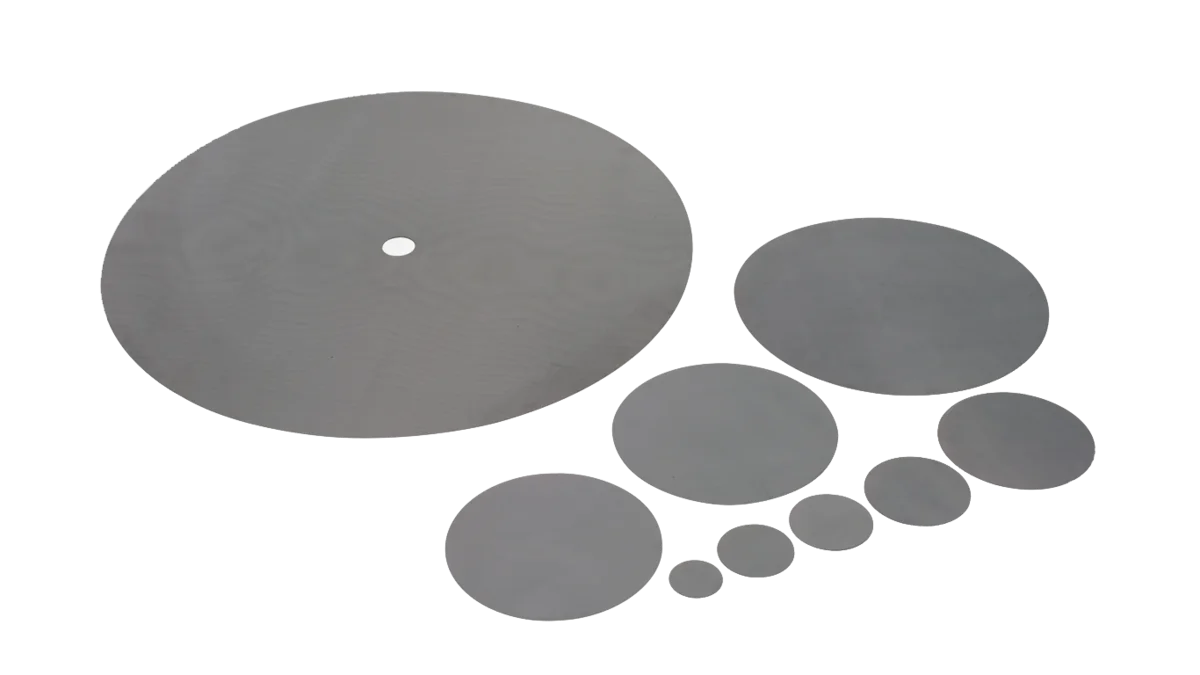
HAVER POROSTAR® wire mesh laminates serve as chromatography frits positioned at both the inlet and outlet of the stationary phase, providing reliable support and retention. They are characterized by outstanding mechanical stability and precise filtration performance, both of which are essential for maintaining the integrity of the stationary phase. At the same time, they ensure optimal flow of the mobile phase. Combined with their ability to prevent unwanted contamination, this results in consistently high elution performance and therefore accurate, reproducible analytical results.
Fully Customizable in Every Dimension
As a filtration medium, HAVER POROSTAR® enables contamination-free filtration at < 1 µm. The filter discs used in these applications are available in a wide range of sizes, from Ø 2.4 mm up to 3 m.
Not only can the dimensions be customized, but also the design and structure of each individual wire mesh layer within the laminate, as well as the total number of layers. These parameters are defined according to the required pore size and other application-specific process requirements.
The key objective is to achieve the optimal balance between separation efficiency and flow rate. The thickness and density of the chromatography frit are equally critical factors in ensuring the desired process performance.
POROSTAR® Overview of available configurations
No fluttering or sagging of the mesh
The filtration mesh layer is responsible for the precise separation performance of the system. To withstand high pressures as well as mechanical, thermal, and chemical stresses, this layer is permanently integrated into a laminate structure with stronger support mesh layers.
The required corrosion resistance is achieved by selecting the appropriate material based on the specific chromatography process.
Proven materials include stainless steels such as Hastelloy C22, 1.4404, and 1.4539.
Cleaning, repair, and replacement of HAVER POROSTAR® Wire Mesh Laminates
The excellent regenerability of the wire mesh laminates makes it easy to integrate regular cleaning routines to remove contaminants and particles that could otherwise affect analytical results. Depending on the application, suitable cleaning methods include mild cleaning agents, soft brushes, compressed air, or ultrasonic cleaning. Due to the robustness of the laminate structure, the use of high-pressure cleaners (fan nozzles) at pressures up to 200 bar is also a proven practice.
“Regular visual inspection of the filter discs is essential. Minor damage, such as loose wires or small holes, can often be repaired and does not necessarily require immediate replacement.”
Christian Fortströer
Head of Filter Media Division
Additional reasons for repair or replacement include:
- Irregularities in the chromatogram or increased pressure during HPLC operation combined with reduced material flow may indicate permanent blockage of the frit. In such cases, replacement of the entire wire mesh laminate, or only the affected area, may be required. Replacement with identical specifications is recommended. Flush weld seams that do not negatively affect separation performance are made possible through our advanced welding expertise.
- Leaks resulting in product loss during analysis may be caused by damage to the laminate or deformation of the frit. In many cases, repair can provide an effective solution.
- Changes in industry standards or manufacturer requirements may necessitate the complete replacement of the filter elements.
Why choose HAVER POROSTAR®
High temperatures, corrosion risks, demanding loads and pressures, and the requirement for consistently high throughput and sustainable production processes are all strong indicators for the use of HAVER POROSTAR® wire mesh laminates in HPLC applications.
While the initial investment is positioned in the premium segment, long-term benefits are realized through reusability, durability, and seamless process integration.
Most importantly, HAVER POROSTAR® minimizes or even eliminates the loss of the significantly more valuable stationary phase.
 North American Website