


You’re all familiar with this: when a fuse trips at home, you go to the fuse box, reset the residual-current circuit breaker (RCD), and power is restored. In electromobility, however, things are not quite that simple. Due to significantly higher voltages and currents, switching devices must possess specific characteristics to ensure vehicle safety.
The challenge
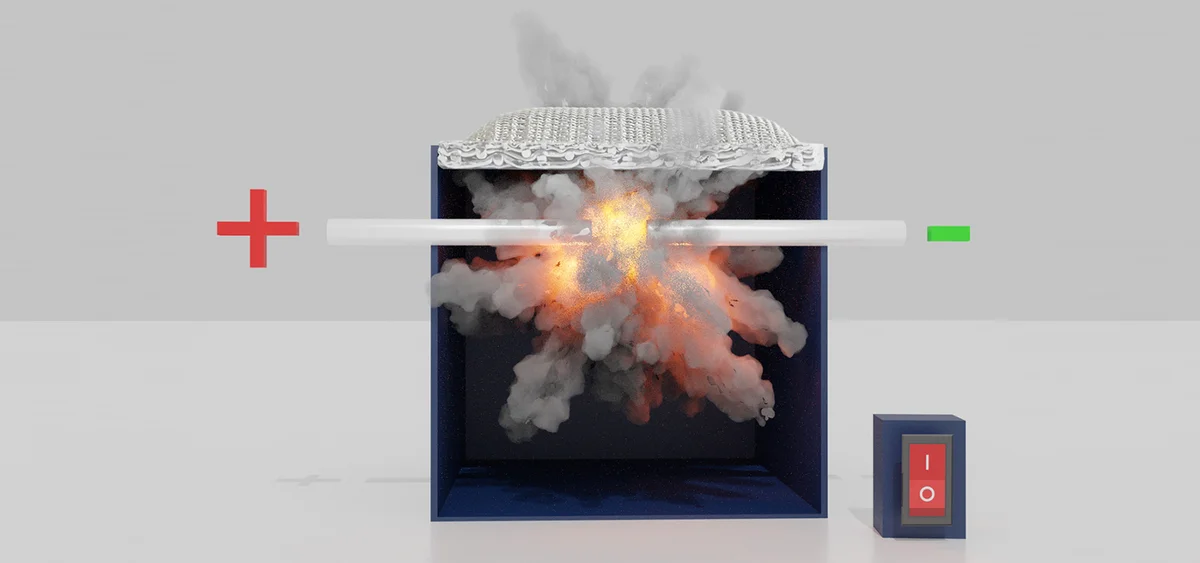
In the event of a short circuit, electrical switching devices in high-current applications are activated automatically. Each switching operation generates an electric arc (spark) inside the arc-extinguishing chamber, which must be safely dissipated. At the same time, every operation causes ionization of the air. If this occurs repeatedly and in rapid succession, the harmless air can turn into an explosive gas mixture. Preventing exactly this scenario is the key challenge.
The solution
Together with our customer, we developed a compacted component made from multilayer wire mesh that enables air exchange within the arc-extinguishing chamber, a phenomenon known in physics as natural convection.
Thanks to the mesh structure, the ionized air generated during a short circuit can escape and continuously be replaced with fresh air, preventing the formation of ignitable gas mixtures. At the same time, the multilayer mesh, with its mass and structural stability, ensures that the electric arc is safely contained and dissipated rather than breaking through to the outside.
Design and mesh details
The compacted mesh components are manufactured using a stamping process and feature a gas-tight edge compaction. The layer structure is individually defined and calculated for the specific electrical switching application. This ensures that the component retains all contaminants down to a specified particle size while simultaneously providing a precisely defined flow rate, which is essential for maintaining natural convection.
To avoid developing customized multilayer wire mesh components through a trial-and-error approach, HAVER & BOECKER introduced CFD (Computational Fluid Dynamics) analyses several years ago. These analyses allow us to model the layer structure and perform a simulation of the physical properties of the design. This enables us to predict in advance which mesh types are best suited for a specific application.
 North American Website