

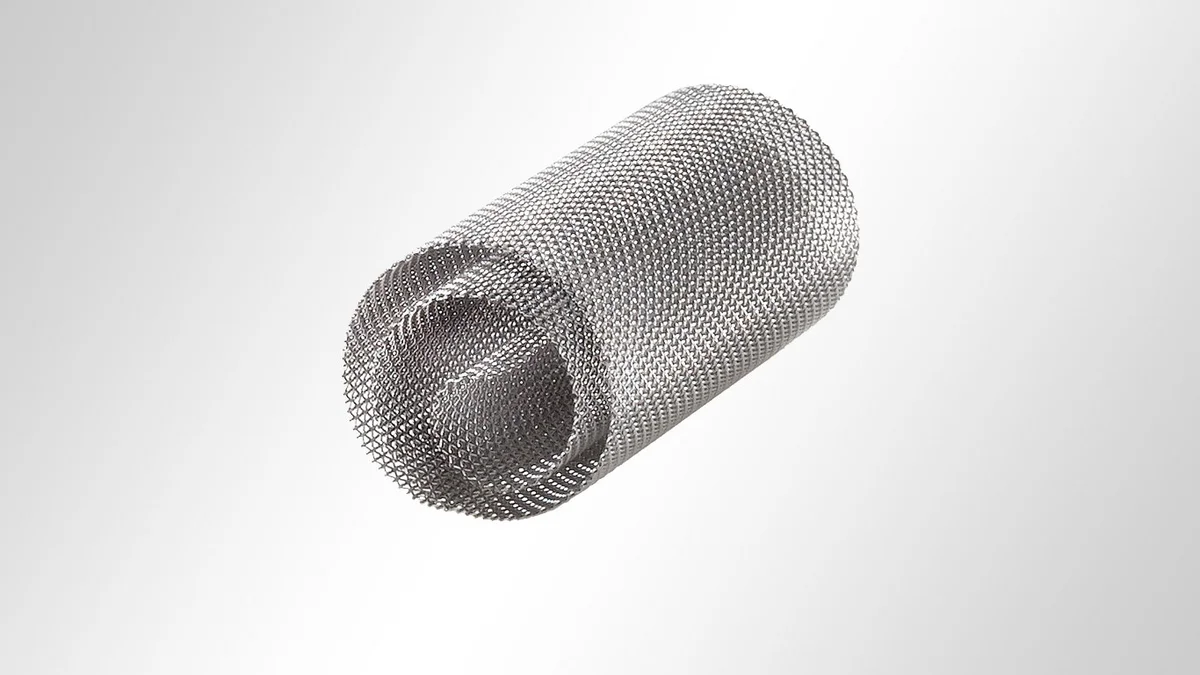

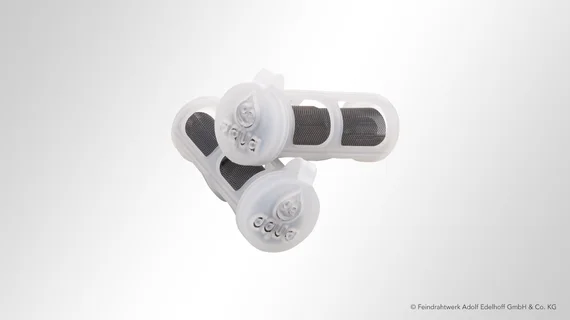
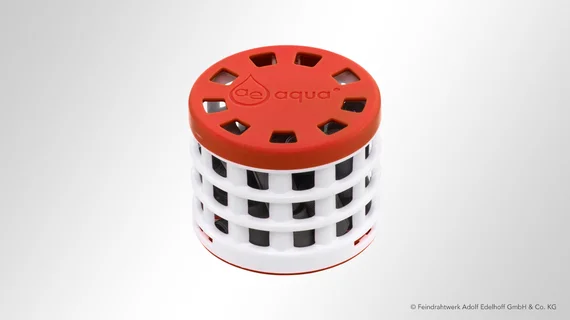
In cooperation with ADOLF EDELHOFF Fine Wire Works, HAVER & BOECKER developed specialized wire mesh rolls for use in both household and industrial applications to extend the service life of liquids and prevent quality losses in production processes. Our wire mesh serves as the carrier material for the precious-metal coating electroplated according to the patented AGXX® technology of ADOLF EDELHOFF GmbH & Co. KG. This coating stabilizes the microbiological quality of water.
Challenge
Have you ever noticed that if you do not change the water in a flower vase for several days, it becomes cloudy and a film forms on the inside of the container? The same thing happens when a coffee machine's water tank is left filled during a vacation.
The reason is that bacteria and microorganisms multiply rapidly in stagnant water. What applies to these household examples also applies to industrial applications, including process water such as rinse water used in electroplating operations and closed-loop cooling systems.
One way to combat bacteria without the use of chemicals, while maintaining long-term water quality, is the patented AGXX® technology developed by ADOLF EDELHOFF GmbH & Co. KG.
Solution
The AGXX® technology functions as a contact catalyst for microbial control in liquids. Its mode of action is based on the generation of a microelectric field on the surface of the ae-aqua rings.
These rings are made from corrosion-resistant stainless steel wire mesh and are electroplated with precious metals. Their design provides the maximum possible active surface area.
HAVER & BOECKER manufactures the metal wire mesh and forms the ae-aqua rings for ADOLF EDELHOFF, where they are subsequently coated using the AGXX® technology.
How the ae-aqua rings work
As soon as the AGXX® mesh is immersed in a liquid, the oxygen present reacts with the microelectric field, generating free oxygen radicals. These radicals penetrate bacterial cell membranes and destroy the microorganisms.
Because these free radicals are highly unstable, they immediately decompose back into water and oxygen. This mechanism, known as the in-situ generation of free radicals, has been officially registered as a biocidal mode of action.
A major advantage of this physical mechanism is that no known microbial resistance has been observed to date.
 North American Website