![[Translate to English:] News](/fileadmin/HaverBoecker/_processed_/0/0/csm_news-v2-1920_9de9c27821.webp)

More performance in less space
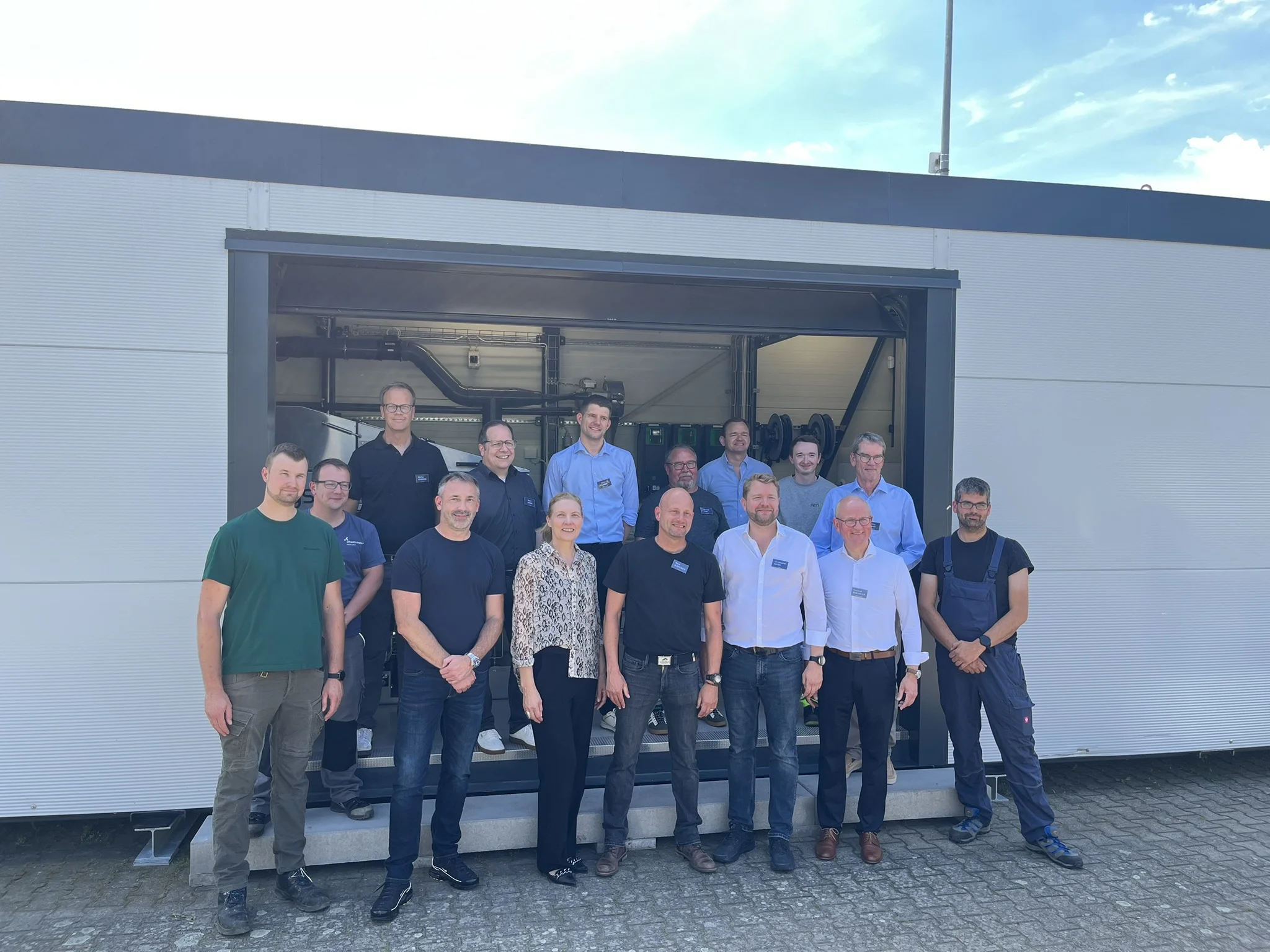
Oelde, late June 2026: A pioneering test phase for the future of wastewater treatment is starting at the Oelde wastewater treatment plant. An innovative microfiltration system from the Norwegian company renasys, implemented together with HAVER & BOECKER, is being used in Germany for the first time – completely without chemical additives. Instead, the system relies on precise mechanical filtration.
Many existing wastewater treatment plants date back to the 1970s and are increasingly reaching their limits due to rising requirements. This is exactly where the pilot project comes in: “In the future, the technology has the potential to replace conventional primary clarification and significantly enhance the performance of modern plants,” explains Niklas Haver, Managing Partner at HAVER & BOECKER. At the core of the system is the three-dimensional MINIMESH® RPD HIFLO filter Mesh from HAVER & BOECKER. It filters particles in the range of 40 to 5 microns – comparable to the ability to separate red blood cells from liquids. This is a striking demonstration of the system’s exceptional separation efficiency.
The system also offers compelling economic advantages: its modular, seamlessly connected design allows for significantly faster installation, requires less space, and reduces costs – while still achieving high performance of up to 50 liters of treated water per second.
The test phase will be scientifically monitored over a period of twelve months. The Institute for Water Management and Climate Future at RWTH Aachen University supports planning and evaluation to ensure an independent and reliable basis for future plant concepts.
The pilot project in Oelde is the first system of its kind in Germany – and is thus emerging as a benchmark for a new form of water treatment: tailor-made, resource-efficient, and jointly developed to meet the challenges of tomorrow’s water management.
 North American Website